Free When Titans Clashed: How the Red Army Stopped Hitler Download Books
Define Epithetical Books When Titans Clashed: How the Red Army Stopped Hitler
| Title | : | When Titans Clashed: How the Red Army Stopped Hitler |
| Author | : | David M. Glantz |
| Book Format | : | Paperback |
| Book Edition | : | Revised and expanded edition |
| Pages | : | Pages: 568 pages |
| Published | : | October 16th 2015 by University Press of Kansas |
| Categories | : | History. Military. Military History. War. World War II. Nonfiction. Military Fiction |
David M. Glantz
Paperback | Pages: 568 pages Rating: 4.13 | 826 Users | 76 Reviews
Ilustration In Favor Of Books When Titans Clashed: How the Red Army Stopped Hitler
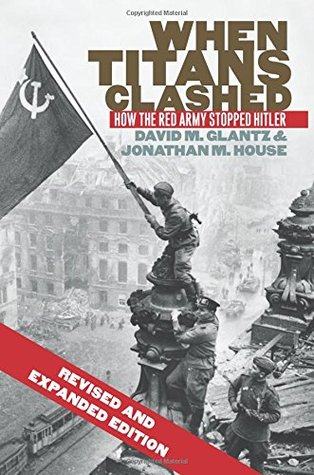
On first publication, this uncommonly concise and readable account of Soviet Russia's clash with Nazi Germany utterly changed our understanding of World War II on Germany's Eastern Front, immediately earning its place among top-shelf histories of the world war. Revised and updated to reflect recent Russian and Western scholarship on the subject, much of it the authors' own work, this new edition maintains the 1995 original's distinction as a crucial volume in the history of World War II and of the Soviet Union and the most informed and compelling perspective on one of the greatest military confrontations of all time.In 1941, when Pearl Harbor shattered America's peacetime pretensions, the German blitzkrieg had already blasted the Red Army back to Moscow. Yet, less than four years later, the Soviet hammer-and-sickle flew above the ruins of Berlin, stark symbol of a miraculous comeback that destroyed the Germany Army and put an end to Hitler's imperial designs. In swift and stirring prose, When Titans Clash provides the clearest, most complete account of this epic struggle, especially from the Soviet perspective. Drawing on the massive and unprecedented release of Soviet archival documents in recent decades, David Glantz, one of the world's foremost authorities on the Soviet military, and noted military historian Jonathan House expand and elaborate our picture of the Soviet war effort - a picture sharply different from accounts that emphasize Hitler's failed leadership over Soviet strategy and might.
Rafts of newly available official directives, orders, and reports reveal the true nature and extraordinary scale of Soviet military operations as they swept across the one thousand miles from Moscow to Berlin, featuring stubborn defenses and monumental offensives and counteroffensives and ultimately costing the two sides combined a staggering twenty million casualties. Placing the war within its wider context, the authors also make use of recent revelations to clarify further the political, economic, and social issues that influenced and reflected what happened on the battlefield. Their work gives us new insight into Stalin's political motivation and Adolf Hitler's role as warlord, as well as a better understanding of the human and economic costs of the war - for both the Soviet Union and Germany.
While incorporating a wealth of new information, When Titans Clashed remains remarkably compact, a tribute to the authors' determination to make this critical chapter in world history as accessible as it is essential.

Present Books Toward When Titans Clashed: How the Red Army Stopped Hitler
| ISBN: | 0700621210 (ISBN13: 9780700621217) |
| Edition Language: | English |
| Literary Awards: | Arthur Goodzeit Book Award (1996) |
Rating Epithetical Books When Titans Clashed: How the Red Army Stopped Hitler
Ratings: 4.13 From 826 Users | 76 ReviewsWrite Up Epithetical Books When Titans Clashed: How the Red Army Stopped Hitler
This book offers a brief overview of the Eastern Front in WW2. The focus is on the Soviet perspective with concentration on the Soviet commanders and units conducting major operations. Glantz works to revise some of the accepted conclusions of the conflict, including the myth that the Soviets used raw numbers to succeed despite clumsy and simplistic tactics. The tables of force strengths and casualties at the end of the book is quite illuminating on the scale and carnage of the conflict.I read this book over ten years ago, so the details are no longer with me.Nevertheless, I can recommend it to anyone with an interest in World War II, particularly if you have a bit of a gap in your knowledge concerning the Eastern Front.The authors of the book are both American military historians; David Glantz is editor of the Journal of Slavic Military Studies.Im not an expert on WW II, but Ive read a number of books in a rather disconnected way, over a period of many years. Once Id gained a
Very good book. Glantz is an expert on the subject and clearly enjoys writing about it. He covers areas of the war other people usually leave out like the winter war of 41-42. However, he gives epic clash at Stalingrad one short chapter. Interesting because Glantz authored a huge three volume set on Stalingrad. His conclusions were all spot on what I have always thought about why the Soviets won and the effect of American aid. ( American aid helped the Soviets win MORE QUICKLY BUT didn't win the
Very good book. Glantz is an expert on the subject and clearly enjoys writing about it. He covers areas of the war other people usually leave out like the winter war of 41-42. However, he gives epic clash at Stalingrad one short chapter. Interesting because Glantz authored a huge three volume set on Stalingrad. His conclusions were all spot on what I have always thought about why the Soviets won and the effect of American aid. ( American aid helped the Soviets win MORE QUICKLY BUT didn't win the
The book is an strategic/operational history of the Red Army throughout the Second World War. It introduces the effects of Stalin's purges and carries on to Barbarossa and beyond. Some interesting points brought up include:-Soviets followed a pre-established defensive plan in July 1941. It just wasn't effective. -Encirclement battle near Kiev in August/Sept 1941 may have delayed the Germans enough to save Moscow.
A great and very well written history and analysis from the prewar to Berlin and a Manchurian bonus of the Soviet experience in the WWII, friendly for the casual reader with an interest in the topic, heavy on the research, notes, statistics and bibliography; about 54% of the book is the narrative of what happened and the rest of the book is dedicated to support material. In my edition, the notes were placed after the narrative and that helped the flow but when I finally arrived it was hard to
Although I had read a number of texts about WW2, this one really opened my eyes. It neatly divide the eastern front into the initial blitzkreig, then the germans get bogged down and finally the Red Army overwhelms the over-extended germans. I docked a star as the various armies are described by their generals but there isn't much back story to any of them and thus they blur into each other (confusingly)


Comments
Post a Comment